


The average website converts just over 2% of its visitors. That means 97 out of every 100 people who land on your site leave without buying, booking, or filling out a form. For years, businesses tried to close that gap with better copy, faster hosting, and endless A/B tests. Those things still matter. But in 2026, the sites pulling ahead have something else in common: they use AI to shape the experience around each individual visitor.
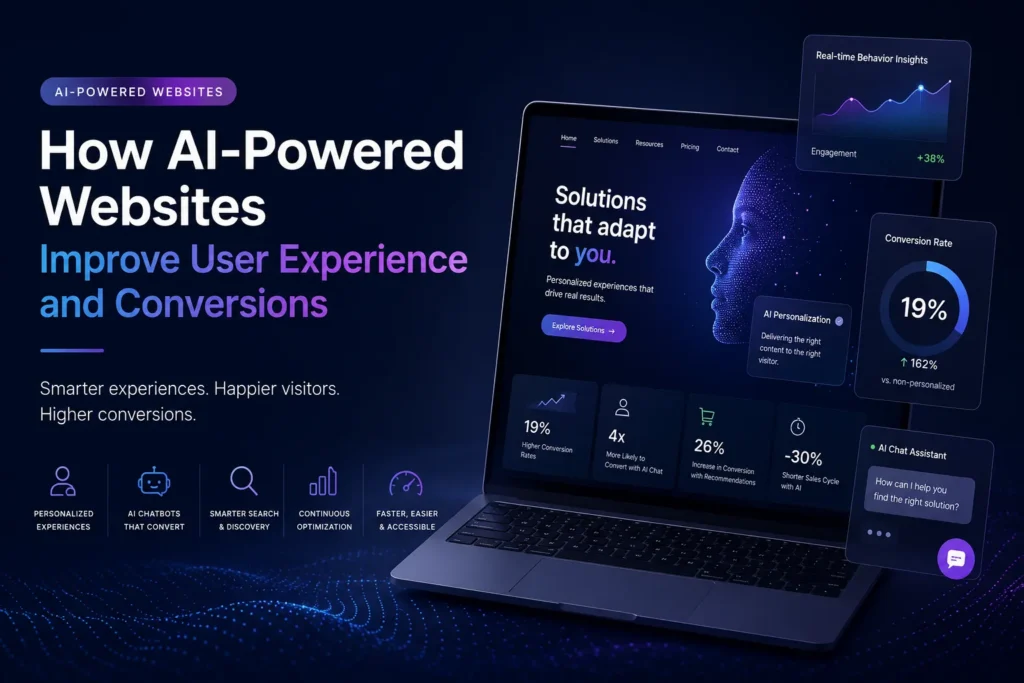
AI-powered websites are no longer a luxury reserved for Amazon and Netflix. Affordable tools now let small businesses and mid-sized brands deliver the same kind of adaptive, personalized experience. And the numbers back it up. Research from Monetate found that websites with personalized content convert at roughly 19%, compared to under 3% for static sites. That is not a marginal improvement. That is a different business.
In this article, we will break down exactly how AI improves user experience, where the conversion gains come from, and how to start without a massive budget.
What Is an AI-Powered Website?
An AI-powered website uses machine learning and behavioral data to adapt in real time. Instead of showing every visitor the same homepage, headline, and product grid, the site studies signals like traffic source, location, browsing behavior, scroll depth, and past visits. Then it adjusts what each person sees.
That can be as simple as a returning visitor skipping the intro and landing on relevant content, or as advanced as a full recommendation engine predicting what someone wants before they search for it. The common thread is this: the website stops being a static brochure and starts behaving like a smart salesperson who remembers every customer.
1. Personalization That Actually Converts
Personalization is the single biggest lever AI pulls. Studies across the industry consistently show AI-driven personalization lifting conversion rates anywhere from 15% to 40%, depending on how deeply it is implemented.
Why does it work so well? Because relevance beats volume. A first-time visitor from a Google ad has different questions than a returning customer from your email list. AI can serve each of them a different hero message, different testimonials, and a different call to action. Even basic tactics deliver results. Personalized CTAs alone have been shown to convert around 200% better than generic ones, and geo-personalized hero images lift lead generation conversions by double digits.
The takeaway for business owners: you do not need to personalize everything on day one. Start with traffic source and new-versus-returning visitors. Even that simple split can produce a 20% to 30% improvement.
2. AI Chatbots That Guide Instead of Annoy
Early chatbots earned a bad reputation for canned answers and dead-end loops. Modern AI chat is a different animal. Today’s bots are trained on your actual products, pricing, and FAQs, and they can answer complex questions, qualify leads, and route visitors to the right page instantly.
The data is striking. Shoppers who engage with a website chatbot convert at roughly four times the rate of those who do not. In B2B, AI-powered conversational bots with intent-based routing are driving over 30% more qualified pipeline on average, and companies pairing bots with CRM data report significantly shorter sales cycles.
The UX benefit is just as important as the revenue. Visitors get answers in seconds instead of digging through pages or waiting on an email reply. Fewer dead ends means fewer bounces. Fewer bounces means more conversions.
3. Smarter Search and Product Discovery
Ever typed something into a site’s search bar and gotten zero results because you used the “wrong” word? AI-powered search fixes that. It understands intent, handles typos, and surfaces relevant results even when the query does not match your product names exactly.
On ecommerce sites, this pairs with recommendation engines, which remain one of the most proven AI applications on the web. Personalized product recommendations increase conversion rates by around 26% and raise average order values by 11%. Amazon’s recommendation engine famously drives about 35% of its total sales. When shoppers click a personalized recommendation, they are over four times more likely to purchase.
For service businesses, the same principle applies to content. AI can surface the right case study, blog post, or service page based on what the visitor has already viewed, keeping them engaged instead of hunting through your navigation.
4. Continuous Optimization Instead of Guesswork
Traditional conversion optimization looks like this: form a hypothesis, run an A/B test, wait weeks, review results, repeat. AI compresses that entire cycle. Teams combining A/B testing with AI-assisted variant generation are running nearly five times more experiments per quarter and winning tests at a meaningfully higher rate.
AI also removes the most common testing mistakes. It calculates statistical significance automatically, so tests are not ended too early. It can run multivariate tests across headlines, images, and layouts simultaneously. And most interestingly, it can serve different winning variations to different audience segments instead of forcing one winner on everyone.
The result is a website that improves every week without a full-time optimization team behind it.
5. Speed, Accessibility, and Fewer Friction Points
AI’s UX contribution is not limited to flashy personalization. Behind the scenes, AI tools now analyze heatmaps, session recordings, and form behavior to find friction points humans miss. Rapid clicking signals frustration. Repeated back-and-forth navigation signals confusion. AI flags these patterns and suggests fixes.
Speed matters here too, because every second of load time costs roughly 7% in conversions, and over half of mobile users abandon a site that takes more than three seconds to load. AI-driven image optimization, predictive preloading, and performance monitoring keep sites fast without constant manual tuning. On forms, AI-powered autofill and progressive profiling reduce the fields a visitor has to complete, and shorter forms can double conversion rates on their own.
Where the Conversion Gains Really Come From
Pull all of this together and a pattern emerges. AI does not convert visitors through magic. It converts them by removing the three things that kill conversions: irrelevance, friction, and delay.
Irrelevance is solved by personalization. Friction is solved by smarter search, better forms, and instant chat answers. Delay is solved by speed optimization and real-time responses. Each fix compounds the others. A relevant page that loads fast and answers questions instantly simply outperforms a static one, every time.
McKinsey’s research puts a bow on it: AI-driven personalization lifts revenue by 5% to 15% and marketing ROI by up to 30%, while cutting customer acquisition costs. The businesses adopting these tools are not just converting better. They are acquiring customers cheaper.
How to Get Started (Without Overbuilding)
A word of caution before you rip out your current site. Fully AI-generated pages without human review have actually been shown to underperform manually crafted pages. AI works best as an optimization layer on top of solid fundamentals, not a replacement for them.
Here is a sensible order of operations:
- Fix the basics first. Page speed under two seconds, mobile experience, and clean checkout or contact flows.
- Add an AI chatbot trained on your real business information, not generic scripts.
- Layer in basic personalization by traffic source, location, and returning-visitor status.
- Introduce AI-assisted testing once you have enough traffic to learn from.
Each stage pays for itself before you invest in the next.
Final Thoughts
The gap between average websites and top performers is widening, and AI is the biggest reason why. Top-performing sites now convert at two and a half to three times the industry average, largely because they adapt to visitors instead of treating everyone the same.
The good news is that the entry point has never been lower. You do not need an enterprise budget to add intelligent chat, personalized content, and AI-driven optimization. You need a solid foundation and a partner who knows which tools actually move the needle. Get those two things right, and your website stops being a digital brochure and starts being your best salesperson.
Frequently Asked Questions
What is an AI-powered website?
An AI-powered website uses machine learning to adapt its content, recommendations, and experience in real time based on each visitor’s behavior, location, and history, rather than showing everyone the same static pages.
How much can AI improve website conversions?
Results vary by implementation, but industry data consistently shows AI personalization lifting conversions by 15% to 40%. Personalized CTAs can convert up to 200% better than generic ones, and visitors who engage with AI chatbots convert at roughly four times the rate of those who do not.
Do small businesses need AI on their websites?
Yes, and the barrier is lower than most owners think. Affordable tools now handle chat, personalization, and recommendations without custom development. Even basic personalization based on traffic source or returning visitors can deliver a 20% to 30% conversion improvement.
Will AI replace human web designers?
No. AI performs best as an optimization layer on top of a well-designed site. Fully AI-generated pages without human review have been shown to underperform. Design strategy, brand voice, and user empathy still require human judgment.
What is the first AI feature a business should add?
Start with an AI chatbot trained on your actual products, services, and FAQs. It delivers immediate UX value by answering visitor questions instantly, and the conversion data from chat engagement is among the strongest of any AI application.