


Your website should be one of the hardest-working parts of your business. It does not take breaks, call in sick, or need vacation time. But for many businesses, the website is still doing the bare minimum. It looks nice, shares basic information, and maybe has a contact form, but your team is still handling every inquiry, booking, follow-up, and customer question manually.
That is where time and money start slipping away. Automated websites help close that gap. Instead of simply displaying information, your website can handle repetitive tasks, respond to customers faster, and keep your business moving even when your team is busy. In this blog, we will explain how automated websites reduce costs, improve efficiency, and help businesses grow without adding more workload.
What Is an Automated Website?
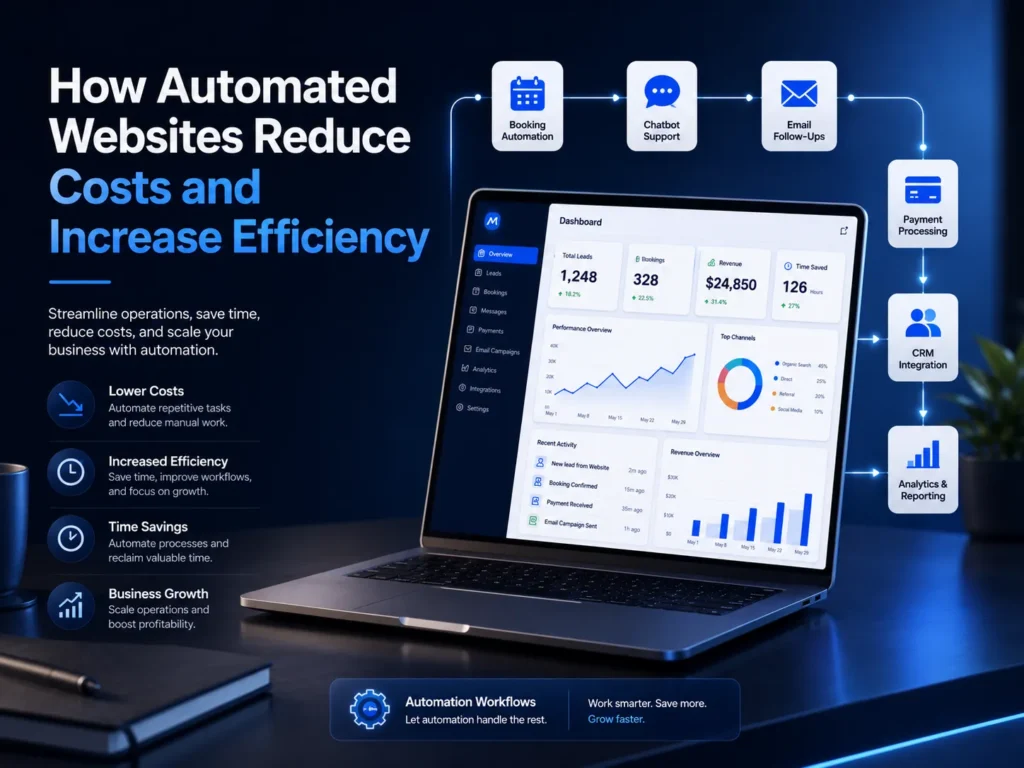
An automated website is a website that can complete routine business tasks without someone on your team doing everything manually. Instead of acting like a simple online brochure, it works more like a digital assistant. It can answer common questions, book appointments, process payments, send follow-up emails, collect customer details, route leads to the right person, and update your records automatically.
Think of the difference this way: a basic website tells people about your business, while an automated website helps run parts of your business. Common examples of website automation include online booking systems that connect with your calendar, chatbots or AI assistants that answer customer questions 24/7, automated email confirmations and follow-ups, payment processing, invoice reminders, lead forms that send customer details directly to your CRM, and customer portals for updates, orders, or service requests.
Each of these features removes a task that someone on your team would normally have to do by hand. That is where the real savings begin.
The Real Cost of Manual Work
Many business owners underestimate how much manual work is actually costing them because the cost is not always obvious. It is spread across small daily tasks that seem simple at first. Someone answers calls to schedule appointments. Someone replies to the same questions over and over again. Someone copies customer details into a spreadsheet. Someone sends reminders, follows up on unpaid invoices, and checks availability manually.
Individually, these tasks may only take a few minutes. But together, they can easily take 15 to 20 hours every week. At a normal hourly wage, that can turn into thousands of dollars per month spent on work that a website could handle automatically. And that does not include hidden costs such as missed calls, slow replies, data entry mistakes, lost leads, and customers choosing a competitor because they responded faster.
Manual work does not only cost money. It can also cost opportunities.
How Automated Websites Reduce Costs
1. They Reduce Repetitive Labor
The most obvious benefit of automation is saving time. When your website can handle bookings, answer common questions, collect customer information, and send confirmations automatically, your team no longer has to spend hours doing those tasks manually.
This does not always mean cutting staff. In many cases, it means your team can focus on more valuable work such as customer relationships, sales, service quality, and business growth. Automation helps your team stop wasting time on repetitive admin work and start focusing on tasks that actually move the business forward.
2. They Help Prevent Costly Mistakes
Manual data entry often leads to mistakes. A name can be spelled incorrectly, a phone number can be typed wrong, an appointment can be added to the wrong date, or a payment detail can be missed. Small mistakes can turn into bigger problems, especially when they affect billing, scheduling, customer service, or communication.
Automated websites reduce these errors by moving information directly from your website into the tools you already use, such as your CRM, calendar, email platform, or accounting software. Fewer mistakes mean fewer refunds, fewer billing issues, fewer missed appointments, and less time spent fixing problems.
3. They Lower Customer Service Workload
Most businesses answer the same questions again and again. Customers ask about business hours, pricing, availability, location, booking steps, and what happens after they submit a request. An automated website can answer these questions instantly through FAQs, chatbots, smart forms, or customer portals.
This gives customers the information they need right away while reducing the number of emails, calls, and messages your team has to handle. The result is better customer service without adding more staff.
4. They Work After Hours
Your team may work from 9 to 5, but your customers do not always search during business hours. Someone may visit your website late at night, early in the morning, or over the weekend. If they cannot book, ask a question, or get a response quickly, they may move on to another company.
An automated website keeps working even when your office is closed. Customers can book appointments, request quotes, make payments, get answers, and receive confirmations at any time. This helps you capture leads and sales that may have been lost with a manual process.
5. They Help You Grow Without Hiring Too Quickly
As your business grows, manual work usually grows with it. More leads mean more calls, more customers mean more follow-ups, more orders mean more admin work, and more bookings mean more scheduling. Without automation, growth often forces you to hire more people just to keep up.
With an automated website, your systems can handle more volume without your costs increasing at the same speed. Whether you have 20 bookings a month or 200, your website can follow the same process automatically. This allows your business to grow more efficiently and protect your profit margins.
How Automation Increases Efficiency
Reducing costs is only one part of the benefit. Automated websites also make your entire business run more smoothly. Customers expect quick responses, and if they have to wait hours or days for a reply, there is a good chance they will contact another business. Automation helps you respond instantly. A customer submits a form and receives a confirmation right away. A lead requests a quote and gets the next steps immediately. A customer books an appointment and receives an automatic reminder.
Automation also connects different parts of your business so tasks do not fall through the cracks. For example, when a customer books online, your website can confirm the appointment, add it to your calendar, send a reminder, collect a deposit, add the customer to your CRM, and send a follow-up email after the appointment. What used to be five or six separate tasks can become one smooth automated process.
Automated websites also help you collect better information. You can see where your leads are coming from, which services people are booking, which forms are performing well, and where customers are dropping off. This information helps you make smarter decisions about your marketing, staffing, offers, and website improvements.
Another major benefit is consistency. Manual processes depend on who is handling the task, how busy they are, and whether anything gets missed. Automation creates a consistent experience. Every customer receives the same confirmation, every lead gets the same follow-up, every booking follows the same process, and every reminder goes out on time. That consistency helps your business look more professional and reliable.
What Website Automation Looks Like in Real Life
Here is a simple example. Before automation, a customer calls to book an appointment. If no one answers, they may not call back. If someone does answer, the appointment may be written down manually, added to a calendar later, and confirmed by email. Then someone may need to send an invoice and follow up for payment.
After automation, the customer books directly on your website. They choose an available time, receive an instant confirmation, get a reminder before the appointment, pay a deposit online, and receive a follow-up email afterward. The customer gets a smooth experience, and your team spends almost no time managing the process manually.
Now imagine that happening across every booking, inquiry, quote request, order, and follow-up. That is where the impact becomes clear.
Where Should You Start?
You do not need to automate everything at once. The best approach is to start with the tasks that take the most time or cause the most delays. For most businesses, the best starting points are online booking or quote requests, automated email confirmations, follow-up email sequences, FAQ automation or chatbot support, payment collection and invoicing, and CRM or lead management integration.
Once these systems are working well, you can add more automation such as review requests, inventory updates, abandoned cart emails, customer portals, and advanced reporting. The key is to build automation in a way that fits your business instead of adding random tools that do not work together.
Final Thoughts
An automated website is not just a nice feature. It is a smart investment for businesses that want to save time, reduce costs, improve customer service, and grow more efficiently. By handling repetitive tasks automatically, your website can reduce manual workload, prevent mistakes, respond to customers instantly, and help your business scale without adding unnecessary overhead.
The businesses that win in 2026 will not simply be the ones working harder. They will be the ones using smarter systems. Your website should not just sit online. It should work for you.
Meta Creative Designer builds automated, conversion-focused websites for businesses that want to grow without increasing their workload. As a Google Partner with over 10 years of experience, we help with everything from website design to automation setup. Contact us today for a free consultation and find out how much more your website could be doing for your business.
Frequently Asked Questions
How much does an automated website cost?
The cost depends on the level of automation your business needs. A website with basic booking and email automation will cost less than a custom system with CRM integration, payment processing, and advanced workflows. The better question is how much your current manual process is already costing you. Many businesses find that automation pays for itself through saved staff hours, faster responses, and more captured leads.
Will automation make my business feel less personal?
No, not when it is done correctly. Automation handles repetitive tasks such as confirmations, reminders, FAQs, and follow-ups. This gives your team more time to focus on real conversations and stronger customer relationships. Customers usually appreciate fast answers, easy booking, and clear communication.
Can my existing website be automated?
Yes, in many cases. Your current website may be able to support booking systems, chatbots, email automation, payment tools, and CRM connections. However, if the site is outdated or poorly built, it may be more cost-effective to rebuild it with automation included from the start. A professional review can help determine the best option.
What should I automate first?
Start with the tasks that take the most time or happen most often. For many businesses, this includes booking, quote requests, email confirmations, follow-ups, common customer questions, payment collection, and lead management. These areas usually provide the fastest return on investment.
Do automated websites work for small businesses?
Yes. In fact, small businesses often benefit the most. When you have a small team, every hour matters. Automation helps reduce admin work, improve response times, and create a more professional customer experience without hiring extra staff. It gives small businesses the power to operate with the speed and consistency of a larger company.