

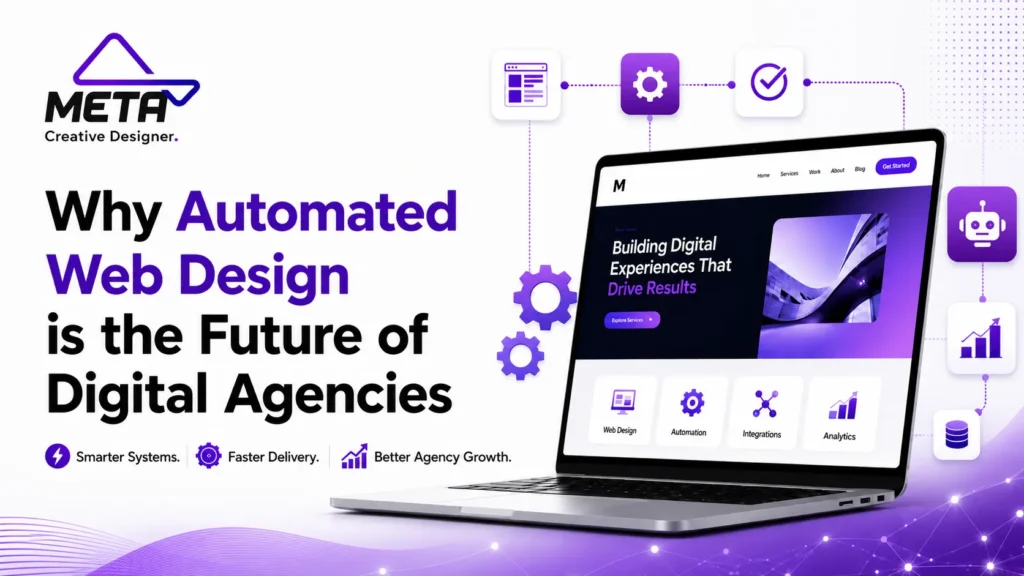

For years, running a digital agency meant one thing above all else: hours. Hours spent coding layouts from scratch, hours tweaking the same components across client sites, hours on revisions that felt endless. The agencies that made money were the ones that could grind through more of those hours than anyone else. That model is now breaking down, and automated web design is the reason why.
At Meta Creative Designer, we have lived through this shift firsthand. The way agencies build, deliver, and scale is changing fast. Automation is no longer a nice extra sitting on the edge of the workflow. It is becoming the workflow. Let us look at why that is happening and what it means for the future of this industry.
What Automated Web Design Actually Means
First, let us clear up a common misunderstanding. Automated web design does not mean robots build entire websites while designers sit idle. That is not the reality, at least not yet. What it really means is that the repetitive, predictable parts of the design process get handled by systems, freeing up humans for the work that actually requires judgment and creativity.
Think of the tasks that repeat on almost every project. Setting up responsive layouts. Generating starter content. Building contact forms and connecting them to a database. Creating consistent style systems. Testing across devices. These steps used to eat up days. Automation compresses them into minutes, and the designer steps in to refine, not to grind.
The result is a hybrid model. Machines handle the heavy lifting of structure and repetition. People handle strategy, aesthetics, and the human touch that no tool can replicate. The best agencies are learning to blend the two rather than choosing one over the other.
Why the Old Model Is Running Out of Road
The traditional agency model has a hard ceiling. Your capacity is tied directly to how many hours your team can work. Want to take on more clients? Hire more people. That means more salaries, more overhead, more management, and slimmer margins. Growth becomes a treadmill that gets harder to run the faster you go.
Clients are also less patient than they used to be. They see fast, polished sites everywhere and expect the same speed for their own project. A six week timeline that felt normal a few years ago now feels slow. Agencies that cannot deliver quickly start losing bids to those who can.
On top of that, price pressure keeps rising. Website builders and templates have taught small business owners to expect lower prices. If your entire value comes from hand coding every pixel, you are competing on a field that keeps tilting against you. Something has to give, and automation is what gives agencies a way out.
How Automation Changes the Economics
Here is where things get interesting for anyone running an agency. Automation breaks the link between capacity and headcount. When systems handle the repetitive build work, a small team can suddenly deliver the output that once required a large one. Margins improve without sacrificing quality.
Faster Delivery, Happier Clients
Speed is the most obvious win. What took weeks can now take days. A client who gets a working draft in a fraction of the usual time feels taken care of and stays engaged. Faster delivery also means you can take on more projects in the same period, which lifts revenue without adding stress to your team.
Consistency Across Every Project
Manual work introduces small inconsistencies. A spacing error here, a mismatched button style there. Automated systems apply the same standards every single time. That consistency raises the baseline quality of everything you ship and cuts down on the revision cycles that quietly drain profit.
More Room for Real Creativity
When your designers are not stuck rebuilding the same footer for the hundredth time, they have energy for the work that actually differentiates your agency. Brand strategy, custom animation, unique visual direction. This is the work clients remember and refer their friends to. Automation does not replace creativity. It clears the runway for it.
The New Value Proposition for Agencies
As automation handles more of the build, the value an agency offers is shifting. It used to be that clients paid you mostly for production, for the act of making the thing. Now they increasingly pay you for outcomes and expertise. That is a healthier place to compete.
Clients do not really want a website. They want more leads, more sales, and a brand they can be proud of. An agency that uses automation to build fast, then layers on strategy, conversion optimization, and ongoing improvement, delivers on what clients actually care about. The website becomes a means to an end rather than the whole product.
This shift also opens up new revenue streams. Instead of a one time build fee, agencies can offer ongoing services powered by automation. Think automated lead systems, content pipelines, and performance dashboards. These create recurring revenue, which is far more stable than chasing the next project every month.
What This Means for Designers Themselves
Some designers hear the word automation and worry about their jobs. That fear is understandable but largely misplaced. Automation is not erasing the need for designers. It is changing what a designer does. The person who only knew how to push pixels manually will need to adapt. The person who understands strategy, systems, and creative direction becomes more valuable than ever.
The designers who thrive in this new landscape are the ones who learn to work alongside these tools. They know how to set up a system, review its output with a sharp eye, and add the human refinement that makes a site feel intentional rather than generated. That skill set is in short supply, and it commands a premium.
In other words, automation raises the floor and the ceiling at the same time. Basic production work becomes commoditized. High level design thinking becomes more prized. Where you sit on that spectrum determines your future, and the smart move is clear.
Common Concerns About Automated Design
Of course, this transition is not without its worries. Let us address the honest ones directly rather than pretend they do not exist.
The biggest fear is that automated sites all look the same. There is truth to this risk. If you rely entirely on defaults, your work will look generic. But that is a choice, not a rule. The agencies that win use automation for the foundation and then customize heavily on top. The tool sets the table. The designer plates the meal.
Another concern is quality control. Faster does not always mean better, and rushing can introduce errors. This is why human review stays essential. Automation should speed up your process, not remove your judgment from it. The agencies that treat automation as a partner rather than a replacement avoid this trap entirely.
How Agencies Can Make the Shift
Moving toward automated web design does not require throwing out everything you know overnight. The smartest approach is gradual and deliberate. Start by identifying the tasks your team repeats on every single project. Those are your first automation targets.
Build reusable systems for the parts that rarely change, like your base layouts, style tokens, and standard integrations. Then connect your website builds to automated workflows for forms, lead handling, and client onboarding. Each piece you automate frees up time you can reinvest into higher value work or additional clients.
Just as important is the mindset shift. Position your agency around outcomes and expertise rather than raw hours. Train your team to work with automation instead of fearing it. The agencies that embrace this early will build a lead that late adopters struggle to close.
The Future Is Already Arriving
Make no mistake, this is not a distant prediction. The shift is happening right now. Agencies across the industry are already blending automation into their process, and clients are already coming to expect the speed and consistency it delivers. Waiting on the sidelines is a decision, and it is a costly one.
The agencies of the future will be leaner, faster, and more focused on strategy than production. They will deliver in days what once took weeks. They will compete on results rather than hours. And they will use the time automation gives back to do the creative, high value work that machines simply cannot do.
At Meta Creative Designer, we see automation not as a threat but as the biggest opportunity our industry has had in years. It lets a focused team punch far above its weight and deliver work that genuinely moves the needle for clients. That is the future, and it belongs to the agencies bold enough to build it.
Frequently Asked Questions
Will automated web design replace human designers?
No. Automation handles repetitive production tasks, but strategy, creative direction, and refinement still require human skill. The role of the designer is shifting toward higher value work rather than disappearing. Designers who learn to work alongside these tools become more valuable, not less.
Do automated websites all look the same?
Only if you rely purely on defaults. The best agencies use automation for the foundation and then customize heavily on top. The tool provides structure, while the designer adds the unique brand identity and creative touches that make each site distinct.
How does automation help a digital agency make more money?
It breaks the link between output and headcount. A small team can deliver far more work in the same time, improving margins. It also enables recurring revenue through ongoing automated services rather than relying only on one time build fees.
Is automated web design lower quality than custom work?
Not when done correctly. Automation actually improves consistency by applying the same standards to every project. Human review remains essential to catch errors and add refinement, so quality stays high while speed increases.
How can a small agency start using automated web design?
Begin with the tasks you repeat on every project, like base layouts, forms, and onboarding. Build reusable systems for those first, then expand gradually. Just as important is shifting your positioning toward outcomes and expertise rather than billing purely by the hour.
Is automated web design only for large agencies?
Not at all. Automation actually levels the playing field for smaller agencies. It lets a lean team deliver the kind of speed and volume that once required a much larger operation, making it especially powerful for growing businesses.